
The Community Trust and Local Autonomy Ordinance
Carlisle Pennsylvania Borough Council Votes 6-1 to Advance Community Trust and Local Autonomy Ordinance
Introduction: What Happened at Our October 9 Council Meeting
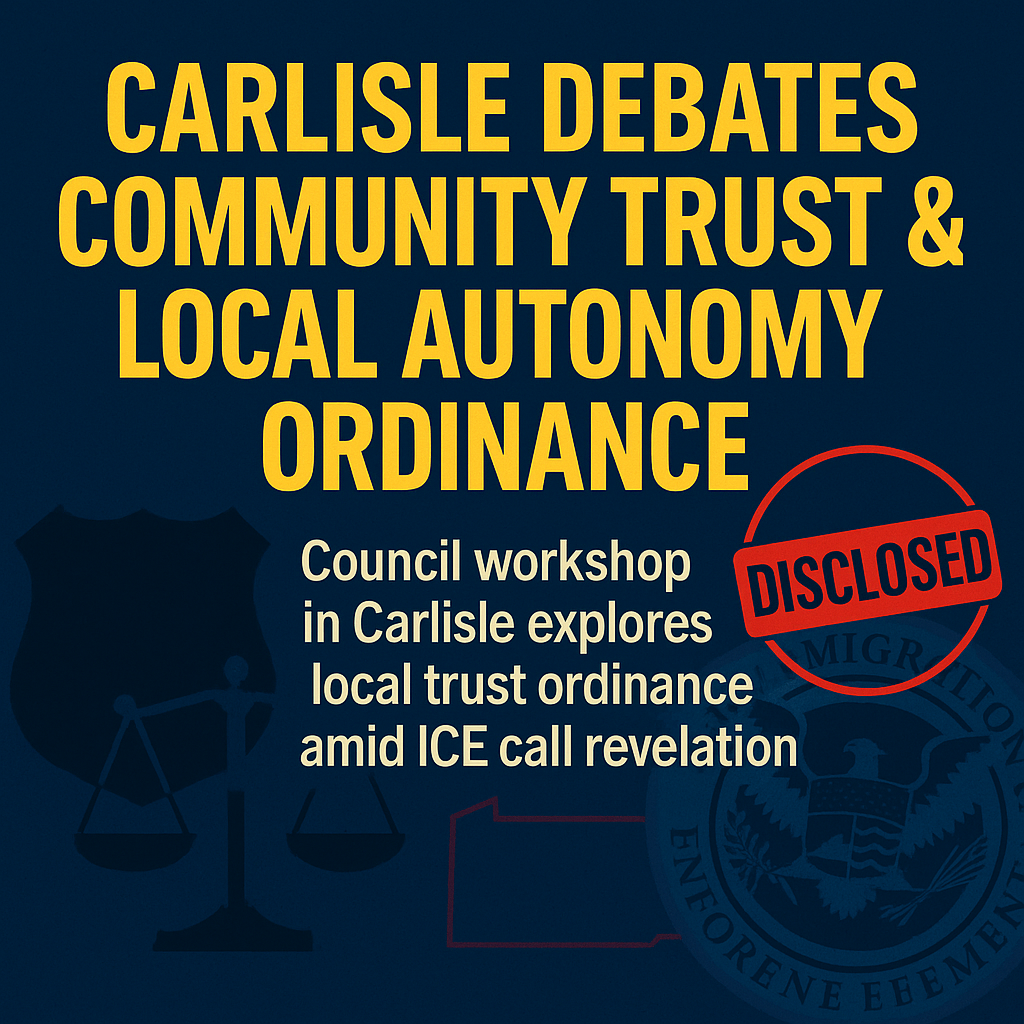
Our Carlisle Borough Council meeting on October 9, 2025 ended with a controversial 6-1 vote that will shape our community’s approach to federal immigration enforcement. The council voted to draft and advertise the “Carlisle Community Trust and Local Autonomy Ordinance,” which will come before our borough for a potential final vote on November 13, 2025. Those of us who attended witnessed extensive public comment and sharp division among our elected officials about whether codifying our borough’s existing practices serves Carlisle’s best interests.
Listen to article…
What Our Mayor Says the Community Trust Ordinance Actually Does
Mayor Schultz addressed concerns that the ordinance would designate Carlisle as a “sanctuary city,” a term he described as “often misunderstood and misused.” According to our mayor, the ordinance formalizes existing practices rather than creating new policy. Mayor Schultz provided specific assurances to Carlisle residents about what the ordinance does and does not do.
The mayor emphasized that our police department already does not engage in immigration enforcement activities. Our officers do not ask about immigration status unless it becomes relevant to a criminal investigation, which represents long-standing departmental practice in Carlisle. A recent five-year review of our police department found only one incident where immigration status was requested, demonstrating what the mayor characterized as departmental restraint.
Mayor Schultz clarified that the ordinance does not prohibit the arrest or detention of undocumented individuals who commit crimes in our borough. If someone violates Pennsylvania state laws or Carlisle local laws, they will be held accountable through our criminal justice system. The ordinance focuses our borough resources on local priorities, ensuring that Carlisle government agents do not act on civil detainer requests or administrative warrants from federal immigration authorities unless those requests are accompanied by a judicial warrant or court order.
The mayor also cited research showing that undocumented immigrants have offense rates approximately half those of native-born citizens, suggesting that concerns about increased crime from the immigrant community lack empirical support.
Our Council Members’ Perspectives on Existing Policy
Councilor Miller, who indicated she would not support the final vote, and Deputy Mayor Landis both noted that much of what the ordinance proposes already constitutes “existing borough policy” in Carlisle. This observation highlights that the primary function of the ordinance would be to codify practices our police department and borough government already follow rather than implementing new procedures.
This raises the central question our community faces: if these practices already exist, does formalizing them through an ordinance serve Carlisle’s interests, or does it create unnecessary risks by making explicit what has previously remained as informal departmental policy?
Why Councilor Melon Cast the Only Vote Against Moving Forward
Councilor Melon provided the sole “nay” vote and articulated strong concerns about potential consequences for our borough. Her opposition centered on the risk of drawing excessive federal attention to Carlisle through the ordinance’s passage.
Councilor Melon’s primary concern involved potential retaliatory action by the federal government against our borough. She warned that federal authorities might freeze funding that has already been allocated to Carlisle or refuse future grant applications for crucial borough infrastructure needs including road work and water system improvements. Given that many Pennsylvania municipalities, including our borough, depend significantly on federal grants for infrastructure maintenance and improvements, this represents a tangible financial risk to our community.
Additionally, Councilor Melon argued that passing the ordinance would likely prompt the federal government to send targeted enforcement raids to Carlisle. In her view, this would paradoxically place our borough’s vulnerable immigrant population at greater risk rather than providing the protection that ordinance supporters intend. Her argument suggests that the current informal policy approach, which has resulted in only one immigration status inquiry over five years according to the mayor’s review, may better serve immigrant residents’ safety than a formal ordinance that attracts federal attention.
Councilor Melon encouraged residents who feel passionately about this issue to pursue the referendum process provided by Carlisle’s Home Rule Charter, which would allow all registered voters in our borough to decide the question directly rather than having our seven-member council make the determination.
What Supporters Said About Community Benefits and Legal Authority
Public supporters and council members who voted in favor of advancing the ordinance presented arguments focused on community values, practical public safety benefits, and constitutional authority.
Several Carlisle residents testified that passing the ordinance would encourage immigrants in our community to participate more fully in civic life, feel comfortable accessing borough services, and increase crime reporting. One resident cited research indicating that Latinos have a 12% higher probability of reporting violent crime victimization after a sanctuary policy is implemented. Another supporter referenced data showing that sanctuary counties average 35.5 fewer crimes committed per 10,000 people compared to non-sanctuary counties.
These arguments suggest that when immigrant community members trust that contact with local government and police will not result in immigration consequences, they become more willing to report crimes they witness or experience, cooperate with law enforcement investigations, and engage with public services. Supporters contend this increased civic participation makes our entire community safer and more cohesive.
Supporters also grounded their position in constitutional and legal principles. Multiple residents referenced the Tenth Amendment to the U.S. Constitution and the anti-commandeering doctrine, which prevents the federal government from requiring state and local officials to enforce federal law. They argued that the ordinance reinforces Carlisle’s home rule authority and our borough’s right to determine how our local resources are allocated rather than being commandeered into federal immigration enforcement activities.
What Happens Next for Carlisle
The 6-1 vote means our borough solicitor will now draft the formal ordinance language and advertise it in our local newspaper, fulfilling the public notification requirements that Pennsylvania law mandates for ordinances. Carlisle residents will have the opportunity to review the specific ordinance language during the notification period.
Our Borough Council will hold a final vote on the Community Trust and Local Autonomy Ordinance at the November 13, 2025 meeting. Between now and that date, our community will continue debating whether formalizing our existing practices through an ordinance serves Carlisle’s interests or exposes our borough to federal retaliation and increased immigration enforcement activity.
Conclusion: The Decision Our Community Faces
The October 9 council vote moved Carlisle one step closer to formally codifying our approach to federal immigration enforcement through a local ordinance. The debate among our council members and residents has clarified the competing concerns that will shape the November 13 final vote.
Supporters view the ordinance as affirming our community values, protecting vulnerable residents, encouraging civic participation, and exercising our constitutional home rule authority. Opponents worry about federal funding retaliation, increased immigration raids, and whether making informal policy explicit serves our immigrant neighbors’ actual safety.
Mayor Schultz’s assurances that the ordinance codifies existing practice rather than creating sanctuary city status may reassure some Carlisle residents while leaving others unconvinced that formalizing these policies is worth the potential risks. Councilor Melon’s alternative suggestion of a borough-wide referendum would transfer the decision from our seven council members to all registered Carlisle voters.
As we move toward the November 13 meeting, those of us who live in Carlisle face a fundamental question: Does our community benefit from explicitly stating our values and practices through a formal ordinance, or does discretion better serve both our borough’s interests and the immigrant families who live here?