
Carlisle Immigration Debate: What Happened When Our Police Chief Disclosed ICE Contact at Council Workshop
Local Resident’s Account of Welcoming Community Ordinance Discussion and Immigration Enforcement Policy in Our Town
Introduction: Why This Carlisle Town Council Meeting Matters to Our Community
Those of us who live in Carlisle, Pennsylvania recently witnessed something unusual at a town council workshop that has significant implications for our community. While most local government meetings in our town focus on routine matters like zoning changes and public works funding, this particular workshop addressed a proposed “Welcoming Community” ordinance that would limit how our local police cooperate with federal immigration enforcement agencies.
What unfolded that evening was more than a typical policy discussion. It was a deeply personal conversation about who we are as a community and how we balance federal law, local policing practices, and the safety and wellbeing of all Carlisle residents. The workshop brought together our neighbors, our police leadership, and our elected officials to grapple with questions that towns and cities across Pennsylvania and the nation are confronting right now. The revelations and testimony presented that evening have given our community much to consider as we move forward.
Listen to article…
Our Police Chief’s Disclosure About an Undocumented Juvenile and ICE Contact
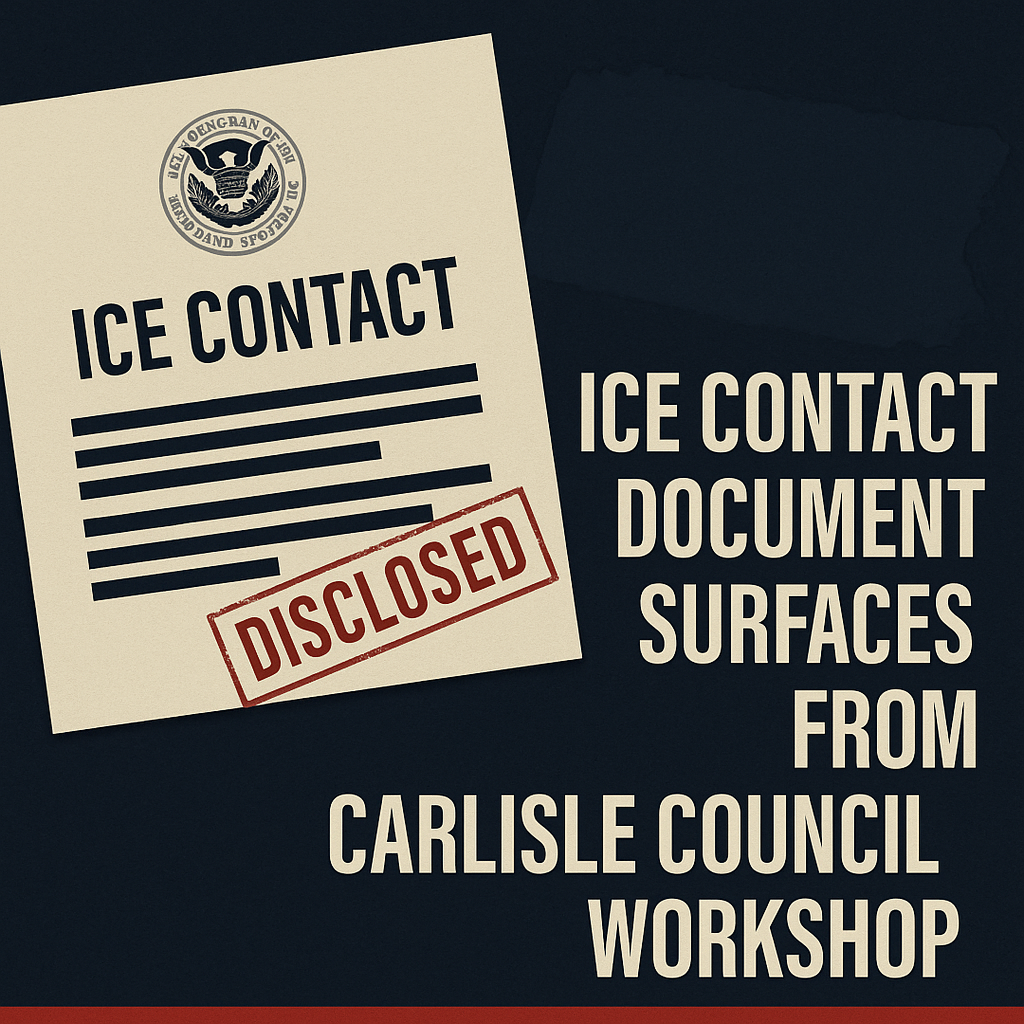
The most significant moment of the workshop came when our Police Chief, Chief Landis, addressed the council with an unexpected disclosure. Chief Landis began by confirming what many Carlisle residents understand to be our department’s standard operating procedure: our officers do not ask people about their immigration status, nor do they proactively contact Immigration and Customs Enforcement.
However, Chief Landis then revealed an incident that represented a departure from that practice. On April 28th of this year, our Carlisle police officers contacted ICE regarding an undocumented juvenile who had been detained. The Chief explained to the council that our officers found themselves unable to release the detained juvenile on their own recognizance and needed assistance locating a responsible party who could take custody. After our officers made that contact, ICE ultimately assumed custody of the juvenile.
What made this disclosure particularly striking for those of us in attendance was learning that Chief Landis himself had been unaware of the incident until September 18th, when he discovered it while processing a right-to-know request. In response to learning about this gap between our department’s stated policy and what actually occurred, the Chief announced that our police department has now implemented new procedures. Going forward, our officers will be required to consult with command staff before any unanticipated interactions with federal, state, and other law enforcement agencies take place.
This revelation transformed our community’s discussion from abstract policy considerations into a concrete examination of what actually happens on our streets when our officers encounter complex situations involving immigration status.
How Carlisle Residents Argued for the Welcoming Community Ordinance
Several of our neighbors who support the proposed Welcoming Community ordinance spoke at the workshop, and their arguments centered on a principle that resonated throughout the room: equal treatment under the law for everyone who lives in Carlisle.
Our fellow residents John Wernern and Jen McDuffy both addressed the council to explain their support for the ordinance. Jen McDuffy articulated the position in particularly clear terms, stating that the ordinance is “not about making our immigrant neighbors immune to the justice system” but rather “ensuring that there’s only one justice system and that that justice system applies equally to everybody.” This framing emphasized that supporters are not seeking to create special protections or exemptions from the law, but rather to ensure that all Carlisle residents, regardless of immigration status, are treated consistently.
John Wernern added another dimension to the argument by suggesting that the ordinance would allow our local police to focus their attention and resources on local public safety matters rather than becoming involved in what he described as “distant politicized bureaucratic” concerns. After Chief Landis revealed the April incident, this argument took on additional weight for many who attended the workshop. The disclosure illustrated how, without clear and binding policy guidelines in place, outcomes can occur that diverge from our police department’s stated intentions and potentially complicate the relationship between our officers and community members.
Economic Data About Immigration’s Impact on Carlisle and Cumberland County
Another Carlisle resident, Amanda Smith, brought a different kind of evidence to the discussion by presenting economic data specific to our region. Smith shared research from the American Immigration Council that quantifies the financial contributions of immigrants living in the Harrisburg-Cumberland County area, which of course includes our town.
According to the data Smith presented, immigrants in our region contribute $660.3 million in local taxes annually. Beyond tax contributions, the immigrant population in the Harrisburg-Cumberland County area represents $1.8 billion in spending power that flows through our local economy. For those of us who own businesses in Carlisle, work in retail or service industries, or simply care about our town’s economic vitality, these numbers provide concrete context for understanding immigration’s role in our community’s financial health.
Smith’s strategy of introducing hard economic data shifted the conversation beyond ideological positions and moral arguments into the realm of practical fiscal considerations. The implicit question her presentation posed to our community was whether policies that might be perceived as unwelcoming could drive immigrant families and business owners away from Carlisle, with measurable consequences for our local tax base, business revenues, and overall economic activity. This economic dimension added a layer of pragmatic consideration to a debate that had largely focused on principles of justice and law enforcement procedures.
Different Perspectives on Community Safety and Sanctuary Policies in Carlisle
The question of public safety generated some of the most passionate exchanges at our town council workshop, with Carlisle residents presenting contrasting perspectives on whether limiting cooperation with federal immigration enforcement would make our community safer or put us at greater risk.
Marvin Salsman, one of our neighbors, expressed concern that restricting how our police cooperate with federal law enforcement could compromise public safety here in Carlisle. Salsman grounded his argument in rule of law principles, noting that our police officers take oaths of office and suggesting that federal immigration laws require local enforcement action. His position reflected concerns that many Carlisle residents share about maintaining order and ensuring that laws are upheld in our community.
Another resident named Carl offered a counterargument drawn from his personal experience living in designated sanctuary cities, including San Francisco and Brooklyn. Carl challenged the assumption that sanctuary policies create dangerous conditions, arguing instead that such ordinances can actually improve public safety outcomes in communities like ours. His reasoning focused on vulnerable populations within our town. Carl explained that victims of domestic violence or human trafficking who live in Carlisle are far more likely to report crimes and cooperate with our police as witnesses when they do not fear that contacting law enforcement will result in deportation consequences.
Carl also shared a personal story about temporarily losing his identification documents and passport, using that experience to help fellow Carlisle residents understand the daily anxiety and vulnerability that undocumented community members may experience. This personal testimony added an element of empathy and human connection to what might otherwise have remained an abstract policy debate.
What This Immigration Policy Debate Reveals About Our Community
As Carlisle residents, we now find ourselves navigating questions that extend far beyond the technical details of law enforcement procedures. Our town council workshop revealed fundamental tensions about community identity, the relationship between local and federal authority, and how we define safety and justice in our neighborhoods.
One of our neighbors, Holden Burke Holder, offered a perspective on local government that many of us could relate to. He noted that while stuck in traffic on Interstate 81 on his way to the meeting, he reflected that our town council cannot fix the traffic problems on that highway. However, our local elected officials can influence and shape our community’s culture through the policy decisions they make. This observation captured something important about the scope and limitations of local government power while also highlighting the very real impact those decisions have on the character of our town.
Conclusion: Moving Forward as a Carlisle Community
The immigration policy discussion at our recent town council workshop has given those of us who live in Carlisle much to think about as our community moves forward. Chief Landis’s disclosure about the April incident with the undocumented juvenile revealed a meaningful gap between our police department’s stated policy and what actually occurred in practice. That revelation has prompted our department to implement new internal procedures, which represents a concrete response to a real problem that emerged in our community.
The economic data presented about the Harrisburg-Cumberland County region provides quantifiable context for understanding how immigration affects our local economy. The $660.3 million in local taxes and $1.8 billion in spending power that immigrants contribute to our area are not abstract statistics but rather numbers that reflect real families, real businesses, and real contributions to the community we share. These figures deserve serious consideration as we evaluate policies that might affect whether immigrant families choose to remain in or leave Carlisle.
The contrasting perspectives on public safety that our neighbors shared at the workshop reflect genuine concerns that exist within our community. Those of us who worry about rule of law and proper enforcement of federal statutes raise valid questions that deserve thoughtful responses. Similarly, those who emphasize that vulnerable populations need to feel safe reporting crimes to our police without fear of deportation are addressing real public safety considerations that affect actual people living on our streets.
As Carlisle continues this conversation, we face a fundamental question about community identity: When gaps appear between stated policy and real-world action, and when tensions arise between federal law and community trust, which values should guide our town’s response? The answer to that question will shape not just our official policies but the lived experience of everyone who calls Carlisle home. Whatever direction our community ultimately takes on the Welcoming Community ordinance, the conversation itself has revealed both the complexity of immigration policy at the local level and the deep investment that Carlisle residents have in getting these decisions right.

![Blog Article Image for Utlimate Guide to White Rocks Trail [AKA White Rock Acres] Hiking Trail, Overlook, and Rock Climbing - Things to do near Carlisle Pennsylvania - Things to do in Boiling Springs Pennsylvania](https://awesomecarlisle.com/wp-content/uploads/2024/11/Gemini_Generated_Image_s3korrs3korrs3ko-150x150.png)