
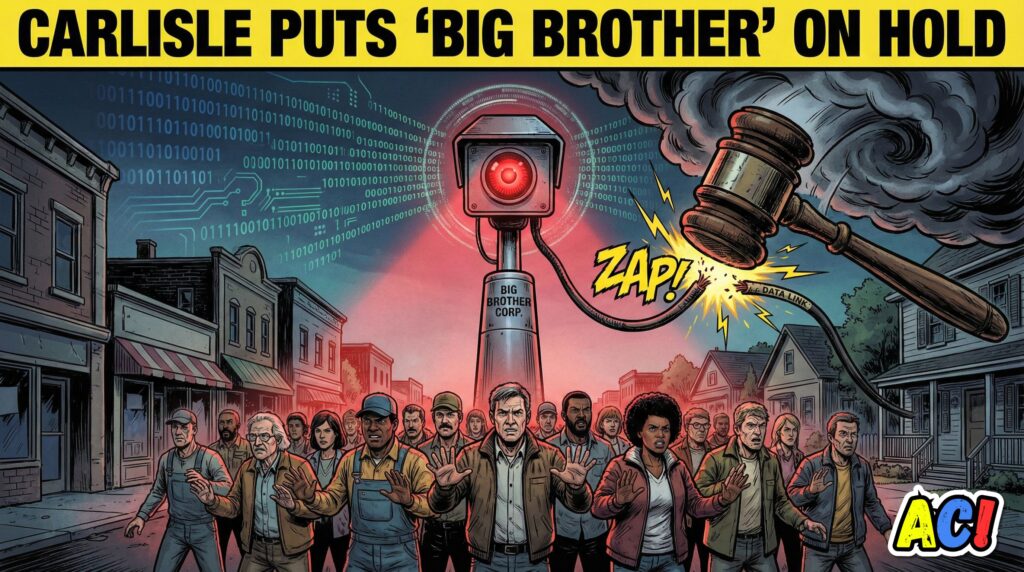

Carlisle Puts “Big Brother” on Hold: Residents Unite Against Flock Surveillance Cameras
A Victory for Privacy at the February Council Meeting
On the night of February 12, 2026, the Carlisle Borough Council meeting took a decisive turn regarding the future of privacy in our town. The agenda included a proposal to enter a multi-year agreement with Flock Safety, a contract worth over $45,000 that would have installed license plate reading cameras within the borough.
However, in a powerful display of civic engagement, residents filled the room and joined via Zoom to voice strong opposition to what many called an “Orwellian” surveillance state. The message from the community was clear: we want a safe neighborhood, but not at the cost of our civil liberties.
Listening to these concerns, the Borough Council voted unanimously to table the motion, effectively hitting the pause button on the contract to allow for further fact-finding. Mayor Schultz, attending virtually, noted after the vote that the borough intends to approach electronic surveillance “very cautiously”.
The Argument: Community Trust vs. Mass Surveillance
The primary theme of the night was the value of community trust. Several residents who recently purchased homes in Carlisle spoke passionately about why they chose this town. They described Carlisle as a diverse, vibrant, and welcoming place—qualities they felt would be eroded by the presence of constant monitoring.
Residents argued that mass surveillance changes the psychology of a neighborhood. Instead of looking out for one another, a system like Flock creates an environment where everyone is constantly watched and potentially judged. One resident noted that communities cannot grow when people are worried about being tracked, suggesting that such systems make neighbors feel like suspects rather than citizens.
Fears of Data Misuse and “Orwellian” Reach
Beyond the general “vibe” of the town, residents brought specific, well-researched concerns about how Flock Safety technology works. The objections were not just about license plates; they were about the aggregation of data.
Speakers pointed out that these systems don’t just snap pictures of cars; they can analyze the shape of a vehicle, bumper stickers, and even the people driving. There was a deep concern about where this data goes. Once the borough gives up control of this data to a third-party private company, it is stored in data centers that are vulnerable to hacking and misuse.
Specific examples were raised regarding how this data is shared nationwide. One resident cited a chilling example from Texas, where a similar system was used by a sheriff’s department to search for women traveling for healthcare (specifically abortion services), highlighting how local cameras can be weaponized for political or legislative agendas outside of Pennsylvania.
Technical Vulnerabilities
The technical security of the Flock ecosystem was also called into question. A resident with technical expertise explained that because Flock is a national network, a vulnerability found in a camera in one part of the country could potentially be exploited to access devices everywhere. The argument was made that even if the Carlisle Police Department uses the system with the best intentions, the system itself represents a massive “threat surface” for hackers and criminals to exploit.
The Resident Roll Call: Who Spoke Up?
The decision to table this contract was a direct result of the following neighbors who stood up to be heard. Here is the list of residents who provided statements regarding the Flock Safety issue:
• Eric Smith (121 South East Street): Eric opened the commentary by stating that privacy is a major opportunity for common ground. He argued that he trusts his neighbors more than external government agencies or private companies. His key point was that once we give up the freedom of controlling our data, “it is very, very hard to put that genie back in the bottle”. He asked that if cameras are used, the data must be restricted from being shared outside the borough.
• Lauren Rosenbaum (506 West High Street): A resident of six years and a new homeowner, Lauren stated she bought her house because she loves the diversity of Carlisle. She told the Council, “We don’t need mass surveillance; we need community with each other.” She warned that the system would take funds away from things we need and put them toward something that actively harms the community.
• Liz Roderick (West High Street / Moving to Pit Street): Liz, who had closed on her house just a week prior, stated, “Mass surveillance has no place in Carlisle.” She argued that the cameras would actively endanger neighbors and invade privacy, emphasizing that she wants to live in a community, “not a surveillance state”.
• Tara Barnard (50 West High Street / Moving to Pit Street): Tara echoed Liz’s sentiments, noting that she decided to stay in Carlisle because it felt safe and welcoming. She warned that Flock would make the town feel unsafe. She also acknowledged her privilege in being able to speak up, noting she was using her voice for members of the community who might not feel comfortable doing so.
• Brian McDermott (343 G Street): Brian shared his experience moving from Eugene, Oregon, where he saw “spyron” cameras installed in public squares. He described the technology as “Orwellian” and “terrifying,” noting that modern AI can track biometric data and vehicle details that could inadvertently criminalize people. He urged the council to do their research, confident they would find the technology is “not good”.
• Tina Ziegler (120 East Louther Street – via Zoom): Tina raised the issue of nationwide searches without warrants. She provided the specific example of a Texas sheriff using the system to search for females seeking abortions. She argued that Flock is the “poster child for data stealing” and making vulnerable citizens accessible to people who should not have access to them.
• Owen Parker (613 North Andover Street – via Zoom): Owen focused on the technical dangers, describing the “national surveillance ecosystem” as having an unprecedented surface for vulnerabilities. He also noted the social cost, stating, “Communities don’t grow when everyone’s always watching,” and that he hopes the plan is swept into the waste bin.
What Happens Next?
For now, the cameras are on hold. The Council voted to table the item, which means it is not dead, but set aside for further review. However, the unanimous nature of the public comment; ranging from new homeowners to tech experts; sent a strong signal to our local government. As we move forward, the residents of Carlisle have made it clear: our privacy is not for sale, and we prefer a neighborhood built on trust rather than technology.